Pages

Tuesday, March 6, 2012

living water and holy of holies

This past weekend was surely a lovely one! It was warm (most of the time), it included floating, catching a tan, hiking, and fellowship. But since I am behind on posting, you will have to wait for all the sweet details of this weekend for a few more days. 

Today I am concentrating on the trip that we took to the land of Manasseh who was the son of Joseph. Joseph being the youngest of Jacob's twelve. Jacob being the youngest of the twin boys of Isaac. Isaac was born to Abraham and Sarah in their ripened age. How do you like that for brief history?:) Now on to the day in the land of Manasseh.

I will be honest with you, it was a freezing, cold day. I believe I had close to 7 layers on my torso --close to an onion, right? In fact, at some point my 2 pairs of socks were not enough so I pulled my cashmere gloves over them. My sneakers felt a bit snug, but my feet were toasty. Any who, with all that said, because of my low body temperature my brain 1) had no desire to take many pictures and 2) could not fully comprehend and remember all the verbal information presented that day.
But i got enough to share some info with you all.     


In John 4:5 illustrates the story where Jesus come to "Jacob's well" and was talking to a Samaritan woman. Remember that story? It is believed (very highly believed with significant proof) that that well is now in the basement of this church (above 2 and lower 2 photos). I do not have pictures of the well, they don't allow it because they want you to buy a postcard of the well for $5. But we were able to send a bucket down, draw up and drink some of the spring water. Never used a well in my life, it was pretty fun. 


Picture above is that of Mount Gerizim where the blessings were to be read (Deut 27:12). Picture below is Mount Ebal, the mountain from which the curses were to be read (Deut 27:13). Shechem is the city between the two. This is where Abraham built an altar for the Lord (Gen 12:6-7). It is also the place where Jacob settled once he left Laban (Gen 33:18). When excavated, it was evident that all type of people groups were found living here. The reason for this is because the city's location was in a prime area; it had routes in every direction and was convenient to have rule over it. However, it was in a valley and could be easily attacked, which it was. So who ever was the strongest, got to rule it. The city is said to be "the uncrowned queen."

When ever Sam sees me taking a picture, he has to strike a pose. He is a funny kid, i would vote him being the class clown. 

At the end of the day we moved on to Shiloh. It was the capital of the Northern kingdom. In Joshua 18:1 it says, "Then the whole congregation of the sons of Israel assembled themselves at Shiloh..." Shiloh was the center of worship for the Israelites until Jerusalem. The ark was kept here until the Philistines took over Shiloh and took the ark (1st Sam. 4:4). Also, Hannah brought her son Samuel and gave him into the Shiloh community (1 Sam. 1).
Shiloh has beautiful, pink almond trees blooming all over. It is also lined with a carpet of red, blossoming poppies. 
There are 3 sites with in Shiloh where the ark of the covenant of God could have been kept while the Israelites were occupying Shiloh. The first possible site is where this church now stands. I believe this church is from the 4th century, but don't quote me on that. Often times churches were built on sites that were considered holy. Therefor, it could be that the ark once stood here.
 Second possible site is here where this watch tower stands. The reason that it could be here is because this is the highest point of the mountain. Usually things that were holy were built/put on the highest points. But it can't be proven because there is no 'tel' to excavate since this tower stands on bed rock.
Where this lovely man stands is the third possible location of where the Ark could have been kept. Although, I can't remember why:/ 
Some other photos from the day:


Friday, March 2, 2012

update: photographs

May I just say how much I love Fridays?! I truly enjoy them because it's a day where we both stay home, cook, catch up on things, etc. It's a complete day of rest (cooking is not considered work, right?:). I will also add that we have totally switched over to Friday and Saturday being the weekend and Sunday being the first day of the week. Ok, now unto the pictures. 

This set was taken over 2 days. First, we visited 11 active (monks and nuns live and take care of the place) monasteries and on day two we visited the wilderness and went to Jericho.
The next few pictures are of the Romanian Orthodox monastery. It's a fairly new compound with a beautiful church and a great hospice. Did you know that hospice does not only mean a home or service caring for the ill and dying? But it also carries the definition of being a lodging place for visitors, especially when it is run by a religious group.
So hospice = hotel. 
The art is absolutely beautiful! From the floor to the ceiling (this is a picture of a ceiling) you have exquisite paintings and the most attention to detail.


Some of the monasteries had collections and displays of human bones, bones that they believe are of the saints. One monastery, the Coptic, supposedly had Lazarus's finger. Another one had a full body of a monk that died over 60 years ago. Now, his body is not in an air sealed case and it's not decaying either. It still has the skin, hair, eyes, etc. which can be seen through the glass (I spared you the picture, thinking many of you wouldn't want a surprising glimpse of a corps). The reason why they keep the bones is because they believe that the Holy Spirit is in the bones of the person.
This mountain is called the "Mountain of Temptation." It is believed that this is where Jesus was taken up and tempted as written in Matthew 4:8. Half way up the mountain you see a long building, this is a Greek Orthodox monastery. This was my favorite monastery! It is so beautiful and unique. It's built right into the mountain, so as you walk you have one side being the bare mountain and the other side is a man made structure. This place also has some pretty awesome caves where monks would retrieve to and enjoy solitude with the Lord. 
Entrance to the monastery.
 These pictures were taken just inside the monastery. As you see, there is solid rock on the right and the rooms/building on the left. These were the only pictures I was able to capture before we were told that we can't take pictures inside. 
Some monasteries have to support themselves my grow crops and selling them in the markets. The husband among green pepper plants. 


Most of the monasteries have caves where you go to be alone with the Lord. However, not everyone can fit without bumping their head once or twice on the ceiling of the cave. 
:( 


This, my friends, is the wilderness. When the Bible speaks of the wilderness, this is what it is talking about. Here you have no source of water, no tree to hid you from the sun, and no one to protect you from wild animals. Your hope? God, and He alone. 
As we were standing on top of the mountain and having class, this bedouin (nomad) fellow and his son saw that we arrived and came to sell us their "goods."

 This boy is so cute! And the donkey surely made us smile as well! It found this patch of grass and simply. would. not. move! The boy tried everything, but the animal just wouldn't budge. The phrase, "stubborn as a donkey," sure came to life. 

Isn't he adorable?!

Can you tell I'm I'm slightly obsessed with this pair? Ok, i'm done now.


 This monastery was a beauty as well. Not to mention the monks served us coffee in cute, miniature cups. Win!

Then came time to cross the wadi. A wadi is a gorge or ravine that is typically dry and waterless, except during the rainy season.

Some made it across with help on both sides.  Isn't this epic?:)
Others got across with a little push from behind.
And some simply didn't make it:(


Still to come is the post on Samaria and.... our three day trip that we are starting tomorrow! Excited to visit the Dead Sea and the Mediterranean. So check back next week for the posting of these lovely events. 
Have yourself a very fabulous weekend!

Wednesday, February 29, 2012

milk, honey, and then some

 The sunshine and the 70 degree weather sure did keep us out and about the last several of days. But let envy not take over your heart, dear snow-bound reader, the rain and cold have dragged me back inside. So here I am with a blanket around my shoulders, the heater on, and a hot cup of tea with in arm's reach; ready to finally share some pictures and a few words on where we have been and what we have seen. 
The pictures are from a few days of travel around the  Holy Land.

This here is the view of Jerusalem from the Mount of Olives. This can be considered as the "honey" of the promise that God gave to Moses concerning Israel in Exodus 3:8. Have you ever wondered why there weren't streams of flowing milk and honey when the Israelites stepped foot into the promise land? The phrase "milk and honey" meant that the land would be fruitful, bountiful, abundant, etc. The "honey" is more referred to the crops of the land. In fact, in Ex 3:8 the word "honey" in Hebrew refers to the thick, very sweet syrup produced my dates (which grow on palm trees) and not bees. Read about the "milk" in the next picture. 
(Land for grazing livestock. You find shepherds and their animals here.)
The "milk" is referred to the livestock of the land. So the promise was that there would be good conditions for crops and livestock in the land. This is interesting because Egypt (where they were) was a great land for crops, harvest, animals, etc (Deut 11:10). It was so good that you could literally part the soil with your foot because it was so moist (Deut 11:10). However, the Promise Land was not that great because it did not have a water source, it's water source was the rain (Deut. 11:11), which is not very stable nor secure. Plus, the land was full of hills and valleys which meant that it had plenty of rocks, tough terrain, etc (Deut 11:11). But the Lord said this of that arid land, "a land (promise land) for which the Lord your God cares; the eyes of the Lord your God are always on it, from the beginning even to the end of the year" (Deut 11:12). And this "He (the Lord) will give the rain for your land in its season, the early rain for your land and the latter rain, that you may gather in your grain, and your wine, and your oil" Deut 11:14. So the Lord brings His people into a land where they must depend on Him. He promises to give them a plentiful land if only they keep His commandment, "to love the Lord your God and to serve Him" (Deut 11:13). How great is that?! It reminds me of Proverbs 3:5 "Trust the Lord your God and lean not on your own understanding."
One last note, the mention of grain, wine, and oil in Deut 11:14 is exactly the order that those crops grow in this land til this very day! The grain comes in around May/June, grapes in August and the olives in Sept/Oct. 

This picture is half of a large wall that holds names of people who have donated at least $1 million to the Hebrew University. Steven Spielberg is one of the names, along with a few banks from New York and some other "American" companies. These donors are from all over the world.
These holes are graves or burials from a very long long time ago. I say that because I don't remember the date that they are dated back to:) People must have been tiny back then.
Sight of the Old City from the Mount of Olives. In the most bottom part of the picture is a cemetery filled with white washed tombs. This cemetery already existed before and during the time of Jesus. On the graves themselves you will not find flowers, instead you will find heaps of rocks, stones, and pebbles. That is the custom here for showing respect to the dead.
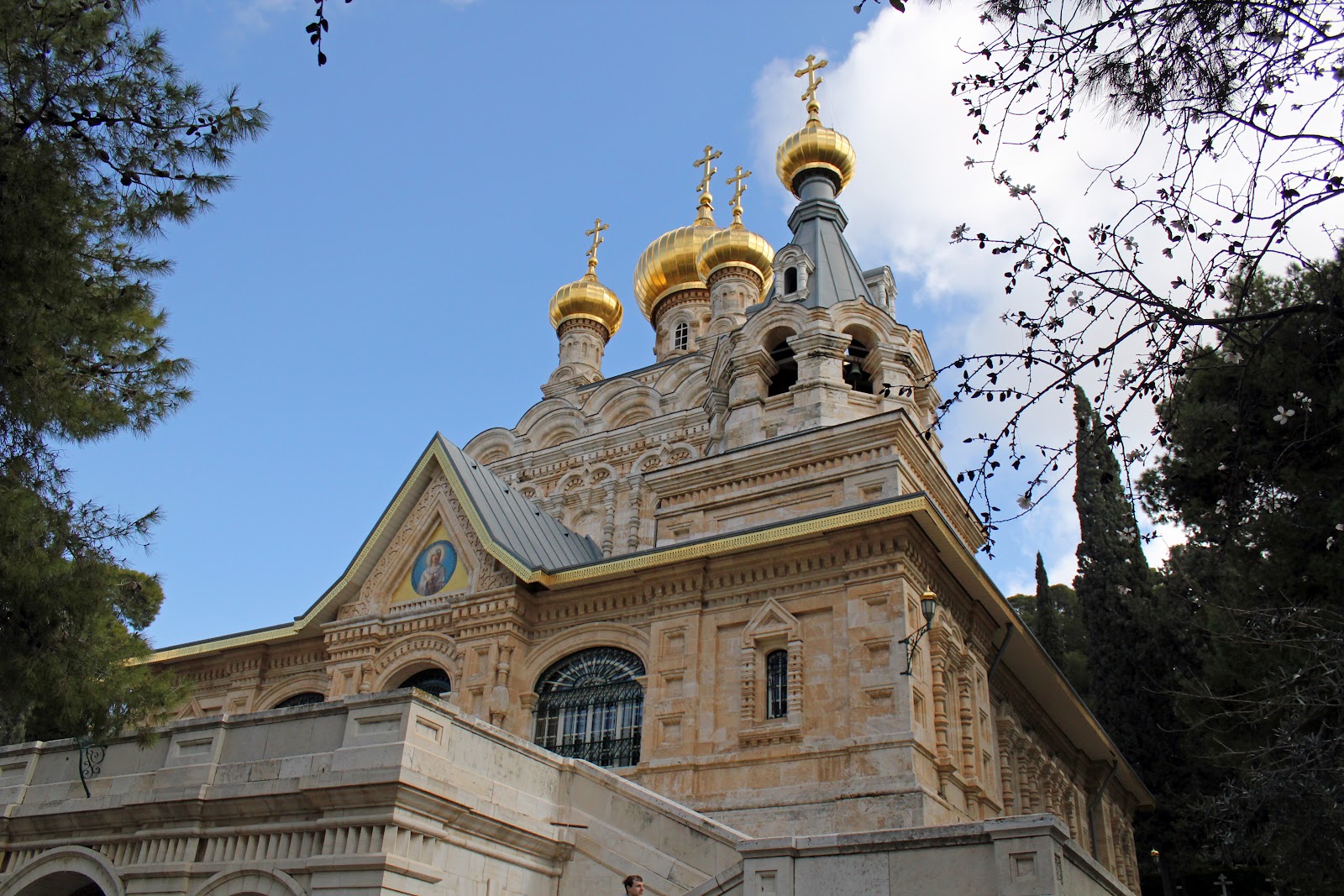
Russian Orthodox church on the Mount of Olives.


The ruins of Herod's getaway spot, Herodium (or Herodian). This fortress stands on a volcano-like hill (758 meters high) that Herod constructed himself. He was very much obsessed with Egypt and wanted the hill to resemble a pyramid, so he ordered that the mount be made bigger so that it was massive and tall. He succeeded, you can see this mount from Jerusalem. The fortress is round, with square rooms. It is said that the place was designed very esthetically with a lot of charm. One of the structures still standing is a sauna, shower, steam room  which is made in a dome like fashion. Many architects today do not know how they were able to achieve the dome structure back then. Herodium also does not have a water source, so Herod brought in the water by stone "pipes." I can't recall all else that was said about him, but this guy was a great builder and inventor. Herod's tomb was discovered here in 2007.


Doesn't this picture remind you of this image?
In Bethlehem, the Church of the Nativity. It supposedly stands on the place/house where Jesus was born.


The doors are so tiny because it said that the inside of the church was very beautiful at one point. But during battles, loss of powers, etc. people groups would go and and take/steal articles from inside the church. At one point, who ever held power over the church at that moment, decided that they would make the entrances and exits tiny so that nothing else could be carried out of the place. 


This is star is believed to be the place where Jesus was born.
Silly, huh?! They may have knocked off the name, but the coffee is no where near Starbucks quality. 
This museum marks the parable of the Good Samaritan and also it is believed that the inn stood where the museum now stands. The museum holds beautiful mosaics from all over and those that are centuries old. 


"I see you..." Oh and yes, those are centuries old tombs that the boys are using as back rests.

On top of a fortress once used by the Crusaders.
The left picture, past the girl is the road to Jericho. See how easy it is to get mugged and even killed? Actually, you can still get mugged and be held at knife point to this day on the road to and from Jericho. 


That's all folks. Next post will be on monasteries, Jericho, the wilderness, and the land of Samaria.