Pages

Wednesday, February 29, 2012

milk, honey, and then some

 The sunshine and the 70 degree weather sure did keep us out and about the last several of days. But let envy not take over your heart, dear snow-bound reader, the rain and cold have dragged me back inside. So here I am with a blanket around my shoulders, the heater on, and a hot cup of tea with in arm's reach; ready to finally share some pictures and a few words on where we have been and what we have seen. 
The pictures are from a few days of travel around the  Holy Land.

This here is the view of Jerusalem from the Mount of Olives. This can be considered as the "honey" of the promise that God gave to Moses concerning Israel in Exodus 3:8. Have you ever wondered why there weren't streams of flowing milk and honey when the Israelites stepped foot into the promise land? The phrase "milk and honey" meant that the land would be fruitful, bountiful, abundant, etc. The "honey" is more referred to the crops of the land. In fact, in Ex 3:8 the word "honey" in Hebrew refers to the thick, very sweet syrup produced my dates (which grow on palm trees) and not bees. Read about the "milk" in the next picture. 
(Land for grazing livestock. You find shepherds and their animals here.)
The "milk" is referred to the livestock of the land. So the promise was that there would be good conditions for crops and livestock in the land. This is interesting because Egypt (where they were) was a great land for crops, harvest, animals, etc (Deut 11:10). It was so good that you could literally part the soil with your foot because it was so moist (Deut 11:10). However, the Promise Land was not that great because it did not have a water source, it's water source was the rain (Deut. 11:11), which is not very stable nor secure. Plus, the land was full of hills and valleys which meant that it had plenty of rocks, tough terrain, etc (Deut 11:11). But the Lord said this of that arid land, "a land (promise land) for which the Lord your God cares; the eyes of the Lord your God are always on it, from the beginning even to the end of the year" (Deut 11:12). And this "He (the Lord) will give the rain for your land in its season, the early rain for your land and the latter rain, that you may gather in your grain, and your wine, and your oil" Deut 11:14. So the Lord brings His people into a land where they must depend on Him. He promises to give them a plentiful land if only they keep His commandment, "to love the Lord your God and to serve Him" (Deut 11:13). How great is that?! It reminds me of Proverbs 3:5 "Trust the Lord your God and lean not on your own understanding."
One last note, the mention of grain, wine, and oil in Deut 11:14 is exactly the order that those crops grow in this land til this very day! The grain comes in around May/June, grapes in August and the olives in Sept/Oct. 

This picture is half of a large wall that holds names of people who have donated at least $1 million to the Hebrew University. Steven Spielberg is one of the names, along with a few banks from New York and some other "American" companies. These donors are from all over the world.
These holes are graves or burials from a very long long time ago. I say that because I don't remember the date that they are dated back to:) People must have been tiny back then.
Sight of the Old City from the Mount of Olives. In the most bottom part of the picture is a cemetery filled with white washed tombs. This cemetery already existed before and during the time of Jesus. On the graves themselves you will not find flowers, instead you will find heaps of rocks, stones, and pebbles. That is the custom here for showing respect to the dead.
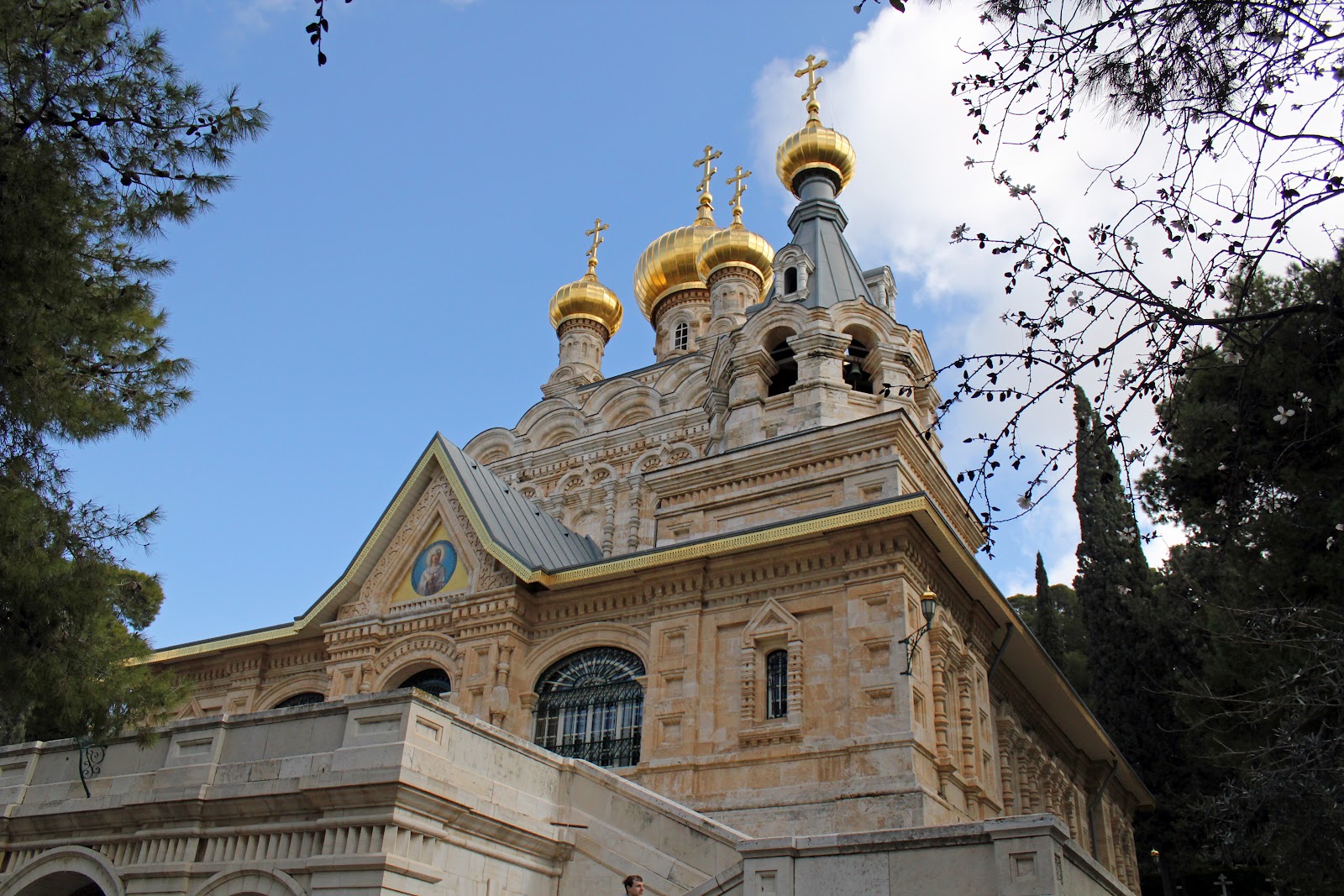
Russian Orthodox church on the Mount of Olives.


The ruins of Herod's getaway spot, Herodium (or Herodian). This fortress stands on a volcano-like hill (758 meters high) that Herod constructed himself. He was very much obsessed with Egypt and wanted the hill to resemble a pyramid, so he ordered that the mount be made bigger so that it was massive and tall. He succeeded, you can see this mount from Jerusalem. The fortress is round, with square rooms. It is said that the place was designed very esthetically with a lot of charm. One of the structures still standing is a sauna, shower, steam room  which is made in a dome like fashion. Many architects today do not know how they were able to achieve the dome structure back then. Herodium also does not have a water source, so Herod brought in the water by stone "pipes." I can't recall all else that was said about him, but this guy was a great builder and inventor. Herod's tomb was discovered here in 2007.


Doesn't this picture remind you of this image?
In Bethlehem, the Church of the Nativity. It supposedly stands on the place/house where Jesus was born.


The doors are so tiny because it said that the inside of the church was very beautiful at one point. But during battles, loss of powers, etc. people groups would go and and take/steal articles from inside the church. At one point, who ever held power over the church at that moment, decided that they would make the entrances and exits tiny so that nothing else could be carried out of the place. 


This is star is believed to be the place where Jesus was born.
Silly, huh?! They may have knocked off the name, but the coffee is no where near Starbucks quality. 
This museum marks the parable of the Good Samaritan and also it is believed that the inn stood where the museum now stands. The museum holds beautiful mosaics from all over and those that are centuries old. 


"I see you..." Oh and yes, those are centuries old tombs that the boys are using as back rests.

On top of a fortress once used by the Crusaders.
The left picture, past the girl is the road to Jericho. See how easy it is to get mugged and even killed? Actually, you can still get mugged and be held at knife point to this day on the road to and from Jericho. 


That's all folks. Next post will be on monasteries, Jericho, the wilderness, and the land of Samaria.


Wednesday, February 22, 2012

a belated update

After receiving a few emails asking if I was okay because I have not updated the blog in a week, I decided to stop the MIA and give you a quick update.

Since my last post we have visited the Mount of Olives (from where Jesus ascended into heaven), we stood and looked into the land of "milk" and then looked at the "honey." We visited a few palaces that Herod built for himself. This guy was a massive, crazy, smart builder! Anything he built was beautiful, economical, and cutting edge. Architects and specialists of today don't fully know how Herod managed to do some of the things that he designed and built back then. We visited the Good Samaritan Museum where it is believed that the inn stood from the story of the Good Samaritan. We also went to Jericho, visited 11 monasteries (beauties!), saw the Church of the Nativity in Bethlehem, and a few other places that I can't seem to remember right now:)

When not in the field of studies or in class I have been reading more and cooking a lot. I am learning new recipes and I find it absolutely delightful to stay home, cook, clean, etc. I think I have successfully taken on the name of "wife." :)
Even though I miss our family and friends, I am taking advantage and am enjoying the social isolation that I am experiencing here. No car to hop into and go to the mall, no obligations or appointments, no one to visit (almost no one, we have made friends with a few couples that we really like and from time to time we gather with them and enjoy that time), etc. Overall, life has really slowed down and that is exactly what I was wanting from this trip. I am enjoying my time in the Word and prayer, time of quietness and thought, and quality time with the husband.
I also have become a communication headquarter! In my entire life I have not written so many emails and Facebook messages than I have here. I love it! It's like receiving a letter in the mail and the content is so rich, personal and encouraging. I am enjoying readying and writing emails, so feel free to write me:)


So friends, that is what I have been up to. I will be posting pictures and words from our trips that I mentioned above. I hope to do that by the weekend if the beautiful weather doesn't drag me outside.


Here are a few fun facts:
1. Israel doesn't have stray dogs, it has a million stray cats. In a 20 minute walk, you can successfully count at least 20 cats.
2. Police sirens sound the same as in the U.S.
3. Most everything here is Kosher, I am Koshered out for life.
4. Climate in Israel is unreal! You could go from rainy, cold 40 degrees to beautiful, sunny 70 degrees just by driving 30 minutes.
5. Tennis shoes/sneakers have become my new best friend.
6. Gap is like considered fancy-shmancy here. Waaaay more expensive than the U.S. and the clothing is of a similar style, but the items are not the same as in America.

Friday, February 10, 2012

classroom time part II

Alrighty boys and girls, ready to start class? :)
 As I have already mentioned many times, our class went on a walk on Sunday. We walked for about 11 hours and covered several thousands of years of ancient history. When you think of the ancient times, do you believe that structures dating thousands of years are still standing? Do you think that people know where each event in the Bible took place and that many physical evidences of it still stand? For example, "Everyone knows where Golgotha is, the 3 crosses still stand!," "This house right here, this is where Jesus had His last supper with the disciples," "Oh, and this, this is David's tomb, isn't it great?!" In all my naiveness, I believed such things until coming here. The truth: not every Biblical site is yet found.
To be frank, I was slightly disappointed to hear that the city of Jerusalem looks very different today comparing to Jesus' day, and the fact that no one can say 100% where Jesus' tomb is. There are plenty of Biblical events where scholars and natives still don't know where they occurred. For example, where exactly King David's tomb is (we do know that it's somewhere in the City of David). In fact, did you know that many physical remains from the ancient world are covered up by years of fill. Think about it, a war occurs and the town gets leveled (that is fill and evidence of that town), then another town gets built on the same spot, it also is destroyed, so on and so forth. Through many decades and centuries these levels of destruction get added, one on top of the other they build a story of evidences of previous life. Like a sign, these layers say, "we were here." This then is where archeology comes in and starts to open up that book of mystery. One page at a time the layers start telling us about the history, civilization, and life hundreds of years ago. Archeology in the last 40 years has peeled away the earth in order to reveal the ancient times; times of the kings, the prophets, and the Messiah.  

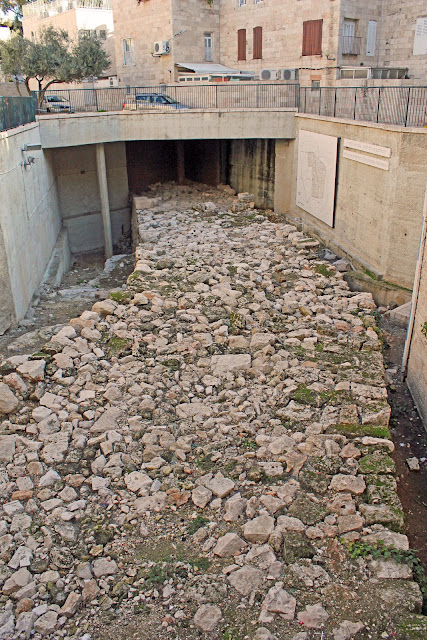
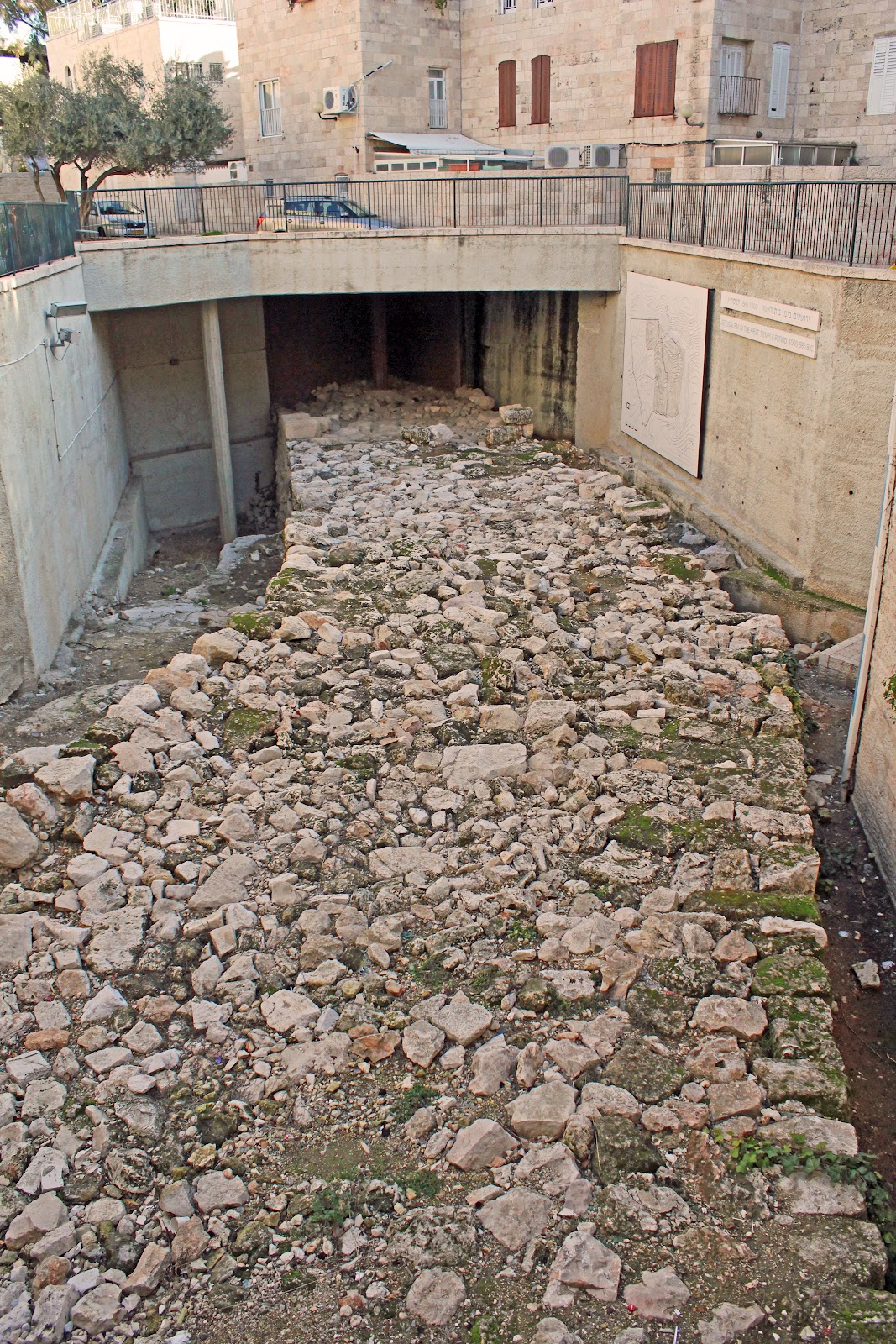
Below is what is called "The Broad Wall." This city wall was build by Hezekiah before 710 B.C. and was excavated sometime after 1967. They estimate that the wall would have been 8 meters high and roughly 20 feet wide (The current City Walls are half the width). The wall also looks like it was just filled in with anything and everything. It is thought that this wall was built very fast, wide and tall in order to with stand the attack from the Assyrians, who were on their way. 
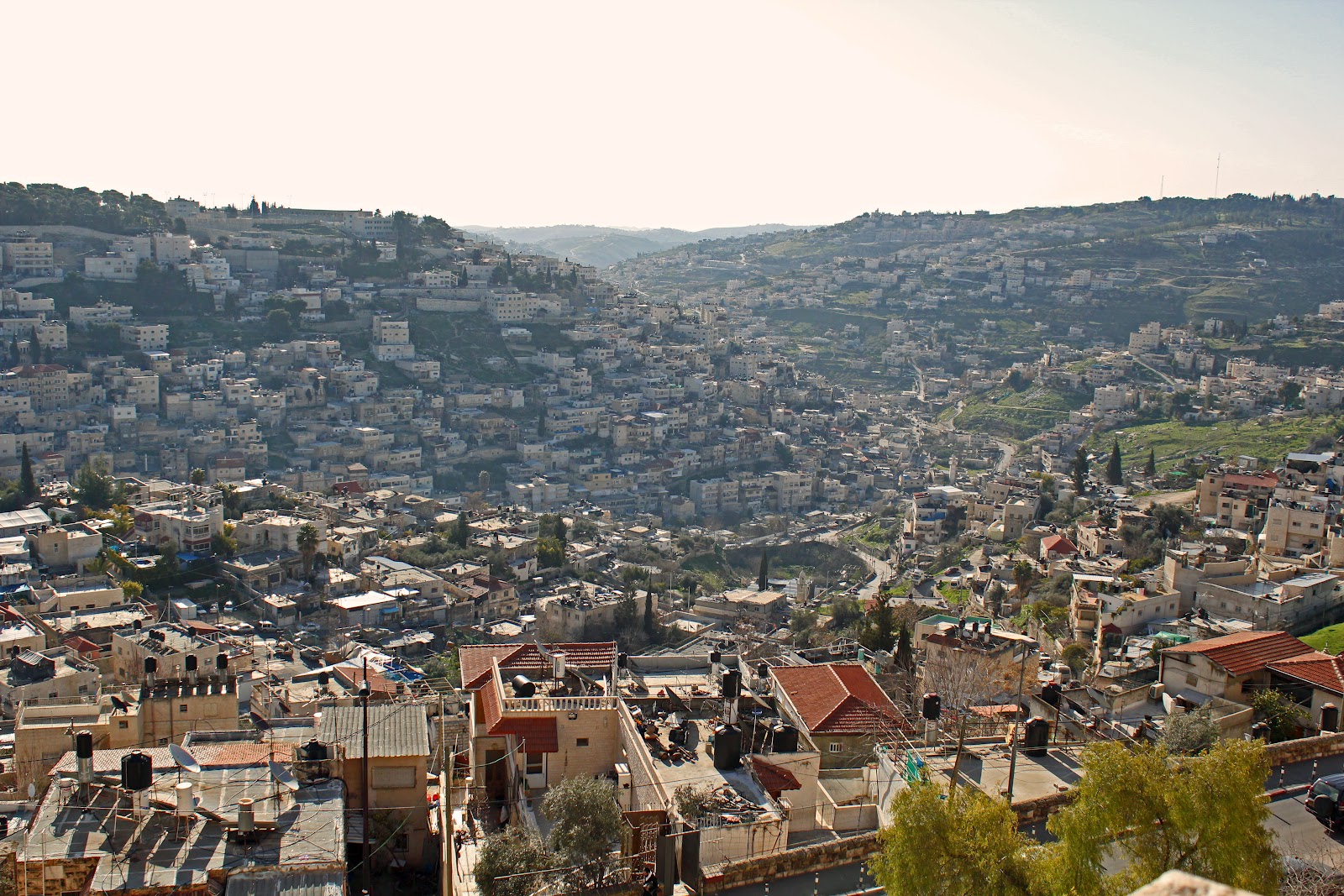
The next picture is of the City of David. No, not all of it. Just the community on the bottom of the picture and to the right. It's a VERY small community which I was so surprised about! Ever read the Old Testament of King David and think that the city was very large? It wasn't. The population was only around 2,000 people during King David's reign. As our professor said, "If you lived back then, you would probably know King David personally." This is why I wrote my last post (Part I), such a small city but God worked wonders through it! He works through the impossible. Also, when you read Psalm 121:1 "I will lift up my eyes to the hills; from where shall my help come? This was a cry for help! City of David is completely surrounded by hills/mountains all the way around, it was and is very easy to get to and attack. His hope was only on God. One last thing, can you see the roof tops? Understand the whole David and Bethsheba thing? Plus keep in mind that back then it was very normal for people to bathe on their roof tops.


This is our class standing on a roof top over-looking the City of David. Everyone was so happy to soak up the sunshine after being in the shade half the morning. 

Left: Not every archaeologist agrees, but some do believe that this was a retaining wall for David's palace. The palace would have stood where that house (info station) now stands. Right: Ancient toilet, perhaps from Joshua's time. Yikes, that's pure, cold, solid, stone.. brrrr.
                                        
     Hezekiah's tunnel

  This site also excavated not long ago. It is the ruins of the temple of the Herodian times. 
This would have been a main street during Jesus' time. It is very very very likely that Jesus walked here. The ruins are from the Roman's attack on Jerusalem 70 AD. There would have been shops on the right hand side, see picture below. 

 These were shops along the main street, perhaps selling animals for offering.

 As you see, the stones are very large in size. There are some stones so large, the estimated weight of them is 200 tons. (Side note: I take pictures and he takes notes for the both of us. Great team, ei?:))

This is the pinnacle of the temple. They would make announcements for the city here. Also, this is believed to be the place where Jesus was tempted by the devil (luke 4:5).
       
 Mount of olives behind us.

These steps are the temple steps. It is here that rabbi's would teach their students and others would gather round to listen. It is believed that on these steps Jesus spoke to the Pharisees and scribes telling them (Matt 23), you "tie up heavy burdens and lay them on men.." you "love the place of honor at banquets and the chief seats in the synagogues and respectful greetings in the market places..." "you are like whitewashed tombs.." "for you build the tombs of the prophets and adorn the monuments of the righteous..." "how will you escape the sentence of Gehenna?" From these steps you can see all the things that Jesus was talking about in this chapter: white tombs (mount of olives) was to the right, the market place to the left, the temple behind, "gehenna" or the Hinnom Valley straight ahead.
And this is us being taught by our teacher:)

Left: Old (during Jesus' time or earlier) stairs in the front and newer stairs further up. Right: Old stairs towards the bottom of the picture and then newer stairs.


Left: Believed to be the pools of Bethesda (John 5:2-9, 14) Right: St. Anne's Church  which is right next to the pools of Bethesda. We (about 30 of us) went into the church and sang a few songs. You would not believe the sound in this place, we sounded like an army of hundreds!

 Outside of St. Anne's Church

Beautiful cyprus trees

We ended the day on a roof top of an Armenian Hospice which over looks the Old City.
That gold dome is "the dome of the rock," it's a masque built in the 7th century. It is smothered in real gold. It also stands where the temple of Solomon once stood.

Tuesday, February 7, 2012

classroom time part I

Our class was out all day Sunday walking through much of Jerusalem visiting sites such as: the Pools of Bethesda, the steps where Jesus taught, ruins of the temple, Hezekiah's tunnel and the City of David. It was in the City of David (I'll explain why here in the next post) where God really stirred my heart again and showed me that He works in ways we do not understand. In fact, He tends to create magnificent results through not so magnificent things. So today I want to post something that didn't have a lot to do with the walk on Sunday, but it was the walk itself that brought me back to these thoughts that I've had for a long time.


Through the last few years, especially the last year, the Lord has been showing me more and more that it is not the strong, mighty things that He works through, but yet, He makes mighty out of the lowly and the weak (1Cor.1:27-28). Such accounts are visible through out the entire Bible, both Old Testament and New Testament. Here are a few examples: God looks to and cares for the lowly (Isaiah 57:15), God chose Israel not because they were great, they were in fact the "fewest of all peoples" (Deut. 7:6-7), those who serve others are the greatest (Matt.20:6-7), the power of the Lord is made perfect in weakness (2 Cor. 12:9).
In fact, Jesus himself was brought into the world in such a "lowly" way, at least by our human standards. He was born of a virgin (Luke 1:34) and accounts have shown that Mary was very young, perhaps only 13 or 14 years of age. WHAT?! If a not married, 13 year-old girl were to get pregnant in todays society (a very liberal society where standards and morals have been erased), it would be shunned upon. How much more true was this in Jesus' time when modesty was of VERY high importance and immorality could get you killed? In fact, Jesus was accused by the Jews of "being born of fornication" (John 8:41). Would you stay away from Jesus because it was said that His parents "sinned" before marriage? Do you stay away from that girl who has a bad reputation because you want to save yours? Or how about that boy whose parents are divorced, is he good for nothing now? Don't judge too severely because you just might be judging the ways of the Lord. Does He not say, "For my thoughts are not your thoughts, nor are your ways My ways," declares the Lord. "For as the heavens are higher than the earth, so are My ways higher than your ways and My thoughts than your thoughts" Isaiah 55:8-9.
 Jesus also did not hold a high ranking job or economical status,  He was a carpenter (Mark 6:3). This was a hard working trade then as much as it is now. He was the King of Kings and the Lord of Lords, making chairs and tables. In addition, He was from Nazareth a town in the Galilee. Judeans despised the Galileans, in addition, the Galileans despised anyone from Nazareth. So in other words, anyone from Nazareth was considered as the lowest of the low and despised by many. That is why Nathanael in John 1:46 says, "Can any good thing come out of Nazareth?" Jesus could have been born into a mighty military family with great reputation, wealth, and prosperity. He could have come from Rome or another city of might, and He also could have been attractive, with majestic clothing. Yet we read in Isaiah 53:2 that He was unremarkable He did not have "stately form or majesty... Nor appearance that we should be attracted to Him." Would you have chosen to be friends with Jesus or would you be 'too good' for Him? Jesus lived as a servant for He said that He came to serve and not to be served (Matt 20:28), He died like a servant (Roman crucifixion was reserved for slaves, criminals and was considered as a shameful death), but rose as Savior.
Being a not-so-handsome carpenter from Nazareth who was allegedly conceived out of wedlock was the King of all Kings, The Lord of glory (1Cor2:8), Wonderful (Is.9:6), Creator of all things (Col 1:16), The Life (1John1:2), The Bridegroom (Matt 9:15), The Bread of Life (John 6:35) and much much more.


So my dear friends, remember that the Lord chooses the weak and poor in order to make them rich in faith, they then are the ones who will inherit everything (James 2:5).


-Natalya


Next post: Classroom Time Part II: Pictures, scripture and some words from yours truly:) 

Saturday, February 4, 2012

an update

The husband and I got the case of the terrible common cold. So that means we have stayed indoors, with a heap of blankets, and eating plenty of soup (not to mention the 20 gallons of tea we each drank). I put a little too much pepper into the soup, so it sure helped to clear those sinuses:) The weather, like us, has also been kind of lousy (of course not as bad as the subzero temperatures that Europe is experiencing), but its been dreary nonetheless: rain, wind, and chilly to the bone. However, today we decided that the 4 walls of our living room were becoming a bit too common and that we needed to see the world again, no matter what the thermostat says.


We set out for a 30 minute walk that turned into 3 hours! The weather was absolutely gorgeous, I believe close to 70 degrees! It felt great to be out again. We had no plans as to where to go so we followed where ever our feet would lead us. First we stumbled upon the most delightful, little gated neighborhood. The streets and steps laid with limestone, all the houses wedged closely together with adorable balconies and porches, ivy running up and down the brick buildings, various fruit trees growing, and all this overlooking a great park. The scene was simply blissful. Vadim and I decided we would live there in a heart beat! That is, if this little town could be moved to the U.S. with ease.


Next we ventured into a few hotels, one of them being the King David Hotel. It is such a charmer! The building first served as a British administrative building of some sort, but then got transformed into a beautiful hotel that is considered to be one of the top hotels in the world. Famous people from all over have stayed there. Names such as: Winston Churchhill, Tony Blair, Mikhail Gorbachev, The Dali Lama, many U.S presidents (Ford, Obama, Roosevelt, Bushx2, Carter, Clinton), and stars such as Sting, Black Eyed Peas, Metallica, Wolf Blitzer, Jean Claude Van Damm, Harrison Ford, and many others. I assume that this crowd likes the "cream of the crop," so you can only imagine how beautiful this place is.
Next we went into the YMCA. Boy, does this place look like a museum more than anything else! It was designed by Arthur Louis Harmon whose firm later architected the Empire State Building in NY. The YMCA actually resembles the Empire State Building, I guess it was Mr. Harmon's guinea pig before the 'real project' :) The inside is very romantic, with a cathedralesque and a pinch of a gothic feel to it. I didn't have a camera with so please look at a few pictures here.
That pretty much wraps up our day. We do feel better and we better be better because tomorrow (Sunday) we wake up at 5:30 am in order to start our 12 hour class period. Our professor is hard core!  We will be walking from 7 am-7 pm as he teaches us about the history (both Biblical and geographical) of Jerusalem and perhaps beyond. I will report on this on Monday, that is if my body will be able to stand or crawl.
Have a great weekend, y'all!


-Natalya


Some information obtained from Jerusalem Insider. Other information obtained from King David Hotel and the YMCA.

Wednesday, February 1, 2012

our cozy little campus

Our school, Jerusalem University College, is nicely nestled into the side of Mount Zion overlooking the Valley of Hinnom (Gehenna Valley). However, before the school was built, one of the walls of the Old City ran up to the property of the college and a watch tower stood where the school now stands. As a matter of fact, the school's office is built into the remains of the tower.
In 1853 Bishop Samuel Gobat opened a school for boys on Mount Zion and named it Bishop Gobat School, creative:). From 1853-1948 it functioned as a school in order to teach under-privileged Arab boys some basic education and a trade that they can implement in life.
In 1948 the war between the Arabs and the Israelis broke out and the school found itself meters away from the cross fires. The Israelis were forced out from the Jewish quarter of the Old City and the Arabs burnt the entire quarter down. Since the school was so close to the Jewish quarter, it became too dangerous to keep children there. So it stopped functioning as an educational institution and instead became a military base since it had a great vertical advantage. Although, some time during or after the war, the school became completely vacant. It remained that way until after the 6-Day War in 1967 where Israelis took back the property (they seized an area 3 times larger than what they had).
In 1967 Dr. Young, a professor from Trinity Evangelical Divinity School in Illinois, took the opportunity to make the desolate building into a school for international students. The American Institute for Holy Land Studies (founded in 1957) moved into the building on Mount Zion and has been there ever since, only changed its name. Dr. Young's goal for the school was to teach the Bible in the land of the Bible and in my opinion, his goal was surely achieved!
This is the school that we go to now. It's a beautiful small campus loaded with history. In its backyard it has the first (and perhaps only) Protestant Cemetery that has been around for over a hundred years. The college also has a 1st century tomb in one of the rooms. So in other words, a lot of dead people around here:) just kidding. But it is surely a campus unlike any other campus I have set foot on, and I think you may agree also. I know that these pictures simply don't do justice to the campus, nonetheless, here they are:


Courtyard between main building and cafeteria
Our student lounge, much like a cave

The picture below is the office. The thresh hold is the mountain itself, see that it's of a different color? 

This is the back yard. Through the arch is a garden and then the cemetery. 

Pomegranates, grapes and kumquats (little oranges that you eat with the peel on. Really good) grow in the garden. 
This gate is what leads to the Protestant Cemetery. It's a beautiful cemetery over looking the valley with many missionaries, reverends,  and other saints who have been laid to rest there.


The plot on the left is the burial site of Horatio Spafford who was a missionary and the author of the song, "It is well with my soul." He has an amazing life story, I encourage you to read about it. The picture on the right is the entrance to an apartment (is connected to the main building) which has a 1st century tomb in it. 


 *All information was obtained from staff at JUC*